Back Safety - Open Page Example The back is the part of the human body that is most susceptible to injury. Approximately 80% of all Americans have back pain at some point in their lives. Over one million Americans suffer back injuries every year. Approximately 25% of all work-related injuries involve the back. Lower back problems are the number one cause of disability in people over age 45.
That is the bad news. The good news is that you can limit your chances of suffering back problems in several ways. First, you can identify important risk factors for back injuries and learn how to avoid them by applying basic ergonomics. Second, you can use strengthening and stretching exercises to help protect your back. Finally, if you do hurt your back, you can minimize your problems and speed up your recovery by recognizing symptoms and getting prompt medical treatment.
Major Stresses to the Back
The back, especially the lower back, plays a primary role in supporting the weight of the body. Even when you are simply standing or sitting, the back is under pressure. In addition, several activities maximize stress on the back. The National Institute of Occupational Safety and Health (NIOSH) identified these risk factors for back injuries:
→heavy physical work
→lifting and forceful movements
→bending and twisting, especially if done frequently or repetitively
→whole-body vibration (e.g. what a truck driver experiences in his or her vehicle)
A separate set of risk factors involves the physical condition of the workers. Inadequate exercise and excessive weight can significantly increase the possibility of suffering a back injury.
Dangers and Techniques of Materials Handling
| By learning the best way to handle materials, you can minimize the strain on your back. Probably the most common and dangerous type of materials handling involves lifting. However, workers also may injure themselves by pushing or pulling materials or by slipping and tripping while handling materials. The U.S. Bureau of Labor Statistics has identified overexertion while moving an object as the cause of about 25% of all workplace injuries. | ![]() 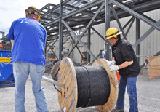
|
Minimizing Stress from Materials Handling
Consider all of the possible ways you might reduce the strain from materials handling and the possibility of a back injury:
→Combine operations to reduce the amount of materials handling.
→Keep products on an as-needed basis instead of stockpiling them for future use.
→Use mechanical devices and equipment (wheelbarrows, carts, dollies, pallet jacks, hoists, and power lifts) for assistance whenever possible. Such assistance is especially recommended when moving objects 10 feet or more.
→Shorten the distances that materials must be moved.
→Store materials at waist height to shorten the distance that they must be lifted and to avoid unnecessary or awkward bending.
→Break a large load into several smaller loads.
→Enlist the assistance of co-workers whenever a load tests your lifting capacity.
Using Good Body Mechanics
When you lift materials, use proper techniques to minimize injury risk:
→Bend at your knees, not your waist.
→Lift with your legs, not your back.
→Keep your head high and your chin tucked in.
→Keep the weight you are lifting close to your body.
→Keep your back straight.
→Create a balanced base of support by using one foot ahead and one foot behind to get the weight in close.
→If an item to be lifted is located in a hard-to-reach place then:
- slide or move the object so that you can lift it close to your body, and
- keep an eye out for nearby obstructions.
→Do not twist your back while moving material. Remember to always keep shoulders in line with hips and pivot your whole body.
→Do not reach with a heavy load.
→Do not move the load away from your body to put it down.
→Do not bend forward at the waist or lift with the back flexed.
→Do not remain in the same position for a long period of time.
The importance of proper lifting techniques cannot be overemphasized. A worker who lifts 20 pounds at arm's length, rather than keeping the weight close to the body, increases pressure on the back by a factor of 10!
Pushing Rather Than Pulling
Generally speaking, it is easier on your back to push something rather than pull it. Pushing provides greater leverage and control.
Reaching for Objects
When reaching for objects:
→Do not reach for an object unless you are sure you have the strength to lift it.
→Use a stepladder to reach objects above shoulder height. Do not depend on inappropriate structures to support you (Examples: a shelf support, a storage rack, a wheelbarrow, etc.). These could easily give way if you pull or tug on them.
→Avoid awkward stretches while reaching. These stress your back and could cause you to lose your balance.
Bending and Twisting Motions
Certain movements and postures tend to place great stress on the back. Probably the two most notorious culprits are bending and twisting motions.
Bending at the waist involves a flexing motion that greatly magnifies the pressure on the back. When you are fully bent over at the waist, the pressure on your back is 250% greater than when you are standing up and 500% greater than when you are lying down!
Twisting motions are also hard on the back. An especially high risk exists if the twisting motion is performed while lifting or moving materials. If you need to turn, do not twist. Pivot instead. Pivoting involves turning your shoulders and feet along with the load, to keep it in front of you at all times.
One of the best ways to avoid bending and twisting motions, as well as awkward postures, is to perform your work within the "comfort zone." For most people, this zone is between the waist and shoulders. When working outside the zone is unavoidable, doing stretching exercises and taking work breaks can help reduce your risk of injury.
Repetitive Movements and "Static Loading"
| Most back injuries can be classified as musculoskeletal disorders (MSDs). These are also knows as repetitive motion injuries (RMIs), repetitive stress injuries (RSIs), and cumulative trauma disorders (CTDs). Repeated stresses combine ("cumulate") over time to harm the muscles, tendons, joints, ligaments, spinal discs, and other parts that make up the musculoskeletal system.Many people mistakenly believe that a single, sudden trauma, such as a car accident or fall, causes the majority of back injuries. Although some back injuries do occur this way, most actually result from repeated strains and stresses over time. Even when it appears that a single trauma caused an injury, other events probably contributed to the problem. In addition, certain diseases of the joints, bones, and discs can predispose us to back problems. | ![]() 
|
Taking Breaks/Changing Positions
Ergonomics, the science of work, teaches us how to do our jobs with less stress and strain in order to avoid MSDs. One of the biggest risks for MSDs is overloading a particular body part. This often happens when a person repeats the same motion over and over again.
Another way to overload your back is to maintain the same posture (especially an awkward one) for a prolonged time period. Technically, this is known as "static loading." The body is designed to move; it does not function well when forced into the same position for long periods of time. The harmful effects include swelling and reduced blood flow in the affected muscles. By not changing positions, you end up taxing specific body parts. Do not stand or sit in the same position for extended time periods.
Body Strengthening and Stretching Exercises
Recent studies have concluded that poor physical condition and excessive body weight can greatly increase the risk of a back injury by stressing the lower back and increasing its curvature. Strong abdominal and back muscles, on the other hand, help support the body and prevent back injuries. This is simply common sense.
We have many different muscle groups to support the spine and to help us move. These muscles include extensors (which straighten the back), flexors (which bend and support the spine), and obliques or rotators (which rotate the spine and help maintain proper posture).
Strengthening exercises may be especially beneficial for the body's joints (where the ligaments attach bones to other bones). As we age, the ligaments in our joints tend to degenerate. This condition is known as "osteoarthritis." By strengthening muscles, we provide more support for our joints and reduce the risk of both osteoarthritis and of injury.
Relatively little effort is required to toughen your back and reduce your risk of injury. As little as 15 minutes a week of strengthening exercises can dramatically reduce your risk. Considering the pain and aggravation from even one back injury, the returns on such a small investment are usually worth the effort.
The use of stretching exercises is another effective way to reduce back injuries. Again, we're simply talking common sense. Our muscles, tendons, and joints need to warm up before they work out. The amount of stretching needed tends to increase as we age, as our strength and flexibility decreases.
Overview of Back, Neck, and Shoulder Injuries and Diseases
The bad news is that back injuries afflict approximately four out of every five adults. Shoulder injuries are common, too, and cause more than 13 million Americans to seek medical treatment each year. The good news is that the vast majority of back injuries fully heal in a relatively short period of time. Approximately 90% of back injuries go away within 13 weeks, and 50% go away within 2 weeks! Most shoulder injuries, too, heal completely with conservative treatment (i.e. non-surgical interventions), although healing does take time. All of this depends, of course, upon getting prompt treatment and allowing adequate recovery time.
Though back problems can have an almost infinite number of causes, most can be placed in one of these basic categories:
→sprains and strains involving soft tissues, such as muscles, tendons, and ligaments
→herniated or bulging discs
→diseases of the back, such as osteoarthritis, rheumatoid arthritis, osteoporosis, and degenerative disc disease
Most shoulder problems are caused by natural, age-related degeneration of the soft tissues that hold this unstable joint together. The majority of shoulder injuries occur in people over the age 60. However, overuse can accelerate this degeneration and cause injuries, too.
Common shoulder injuries include:
→dislocation or separation
→rotator cuff diseases and disorders, such as tendonitis, bursitis, and torn rotator cuffs
→"frozen shoulder," which is a disorder in which the range of movement is severely restricted by pain and abnormal tissue growth
→osteoarthritis and rheumatoid arthritis
Sprains and Strains of the Soft Tissues
| Approximately 90% of all back injuries involve torn muscles or tendons (sprains) or torn ligaments (strains). Sprained muscles typically heal quite quickly. Tendons are denser and more fibrous and take longer to heal. Ligaments are the densest material of all, as they usually connect bones to other bones. Severely strained ligaments typically take the longest time to heal.Sprains and strains can be mild (Grade I), moderate (Grade II), or severe (Grade III). Mild or moderate symptoms generally can be treated with aspirin or other anti-inflammatory, non-prescription medicines. In addition, a cold pack applied for 10 to 30 minutes within 48 hours after injury may help to reduce swelling and relieve symptoms. Once you can return to relatively normal activities, your doctor may recommend exercises or physical therapy to complete your healing process and teach you how to avoid relapse. Even severe sprains and strains usually heal completely. However, disease or damage to ligaments in joints may lead to chronic pain in extreme cases. Over half the people who suffer a sprain or strain will experience another episode of back pain within a few years. Because a relapse may involve more severe symptoms or even a totally different problem, keep a close eye on your condition and see a doctor as needed. | ![]() 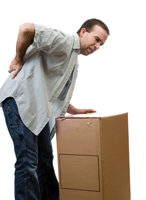
|
Herniated or Bulging Discs
While lifting an object at work, you feel a "pop" in your lower back, like a pulled muscle. The pain is mild at first, but steadily worsens. A few days later, you feel a new sensation: a shooting pain down your leg. It hurts a lot worse whenever you cough, sneeze, or sit down.
This scenario probably involves a protruding disc, the most common cause of severe back pain. Protruding discs are commonly known as herniated discs or bulging discs. When a disc "herniates," the hard outside ruptures and the softer center spills outside. When a disc "bulges," the outside does not actually tear. Generally speaking, herniated discs are more serious than bulging discs. However, bulging discs can cause severe symptoms, especially if the protrusion is large.
Symptoms
The symptoms from protruding discs vary widely in type and severity. They may include severe backache with disabling muscle spasm or no backache at all. In addition, protruding discs often, but not always,
impinge on surrounding nerves and cause pain to radiate into the leg or foot (with a lumbar disc) or arm (with a cervical disc).
Nerve compression from a problem disc may involve shooting pain, numbness, or tingling in the affected body part served by the nerve.
Severe cases may even lead to weakness and wasting away of the surrounding muscle. An especially severe nerve root compression involves loss of bladder or bowel control, as well as weakness in both legs. This is very serious and requires immediate medical attention.
Diagnosis
The diagnosis of a bulging or herniated disc involves a review of the patient's history to detect if symptoms of a problem disc are present.
Other Disorders and Diseases of the Back, Neck, and Shoulders
There are many conditions besides muscle sprains, ligament strains, and bulging discs that can cause back problems.
The sources and severity of back, neck, and shoulder pain vary greatly. To obtain a better understanding of your problems, and to speed your recovery, visit a medical professional.
Safety Empowers Excellence
Although the vast majority of back problems quickly resolve, they can
become chronic (last over 6 months) in 5 — 10% of cases. If your condition worsens or does not improve after several days, promptly see a doctor. The doctor can help to pinpoint your condition, as well as recommend appropriate treatment to speed your recovery.
Follow the doctor's advice on lifting and other activity restrictions. Torn tissue and damaged discs leave your back vulnerable to additional serious injury. By failing to follow your doctor's orders, you run a big risk of turning a minor, short-term back problem into a major, chronic one.