 |
§393.11 — Lamps and reflective devices | (a) (1) Lamps and reflex reflectors. Table 1 specifies the requirements for lamps, reflective devices and associated equipment by the type of commercial motor vehicle. The diagrams in this section illustrate the position of the lamps, reflective devices and associated equipment specified in Table 1. All commercial motor vehicles manufactured on or after December 25, 1968, must, at a minimum, meet the applicable requirements of 49 CFR 571.108 (FMVSS No. 108) in effect at the time of manufacture of the vehicle. Commercial motor vehicles manufactured before December 25, 1968, must, at a minimum, meet the requirements of subpart B of part 393 in effect at the time of manufacture. |
(2) Exceptions: Pole trailers and trailer converter dollies must meet the part 393 requirements for lamps, reflective devices and electrical equipment in effect at the time of manufacture. Trailers which are equipped with conspicuity material which meets the requirements of §393.11(b) are not required to be equipped with the reflex reflectors listed in Table 1 if — (i) The conspicuity material is placed at the locations where reflex reflectors are required by Table 1; and |
(ii) The conspicuity material when installed on the motor vehicle meets the visibility requirements for the reflex reflectors. |
|
|
(b) Conspicuity Systems. Each trailer of 2,032 mm (80 inches) or more overall width, and with a GVWR over 4,536 kg (10,000 pounds), manufactured on or after December 1, 1993, except pole trailers and trailers designed exclusively for living or office use, shall be equipped with either retroreflective sheeting that meets the requirements of FMVSS No. 108 (S5.7.1), reflex reflectors that meet the requirements FMVSS No. 108 (S5.7.2), or a combination of retroreflective sheeting and reflex reflectors that meet the requirements of FMVSS No. 108 (S5.7.3). The conspicuity system shall be installed and located as specified in FMVSS No. 108 [S5.7.1.4 (for retroreflective sheeting), S5.7.2.2 (for reflex reflectors), S5.7.3 (for a combination of sheeting and reflectors)] and have certification and markings as required by S5.7.1.5 (for retroreflective tape) and S5.7.2.3 (for reflex reflectors). |
(c) Prohibition on the use of amber stop lamps and tail lamps. No commercial motor vehicle may be equipped with an amber stop lamp, a tail lamp, or other lamp which is optically combined with an amber stop lamp or tail lamp. Table 1 of §393.11 — Required Lamps and Reflectors on Commercial Motor Vehicles | Item on the vehicle | Quantity | Color | Location | Position | Height above the road surface in millimeters (mm) (with English units in parenthesis) measured from the center of the lamp at curb weight | Vehicles for which the devices are required |
|---|
| Headlamps | 2 | White | Front | On the front at the same height, with an equal number at each side of the vertical center line as far apart as practicable | Not less than 559 mm (22 inches) nor more than 1,372 mm (54 inches) | A, B, C | | Turn signal (front). See footnotes #2 and 12 | 2 | Amber | At or near the front | One on each side of the vertical centerline at the same height and as far apart as practicable | Not less than 381 mm (15 inches) nor more than 2,108 mm (83 inches) | A, B, C | | Identification lamps (front). See footnote #1 | 3 | Amber | Front | As close as practicable to the top of the vehicle, at the same height, and as close as practicable to the vertical centerline of the vehicle (or the vertical centerline of the cab where different from the centerline of the vehicle) with lamp centers spaced not less than 152 mm (6 inches) or more than 305 mm (12 inches) apart. Alternatively, the front lamps may be located as close as practicable to the top of the cab | All three on the same level as close as practicable to the top of the motor vehicle | B, C | | Tail lamps. See footnotes #5 and 11 | 2 | Red | Rear | One lamp on each side of the vertical centerline at the same height and as far apart as practicable | Both on the same level between 381 mm (15 inches) and 1,829 mm (72 inches) | A, B, C, D, E, F, G, H | | Stop lamps. See footnotes #5 and 13 | 2 | Red | Rear | One lamp on each side of the vertical centerline at the same height and as far apart as practicable | Both on the same level between 381 mm (15 inches) and 1,829 mm (72 inches) | A, B, C, D, E, F, G | | Clearance lamps. See footnotes #8, 9, 10, 15 & 17 | 2 | Amber | One on each side of the front of the vehicle | One on each side of the vertical centerline to indicate overall width | Both on the same level as high as practicable | B, C, D, G, H | | 2 | Red | One on each side of the rear of the vehicle | One on each side of the vertical centerline to indicate overall width | Both on the same level as high as practicable | B, D, G, H | | Reflex reflector, intermediate (side) | 2 | Amber | One on each side | At or near the midpoint between the front and rear side marker lamps, if the length of the vehicle is more than 9,144 mm (30 feet) | Between 381 mm (15inches) and 1,524 (60 inches) | A, B, D, F, G | | Reflex reflector (rear). See footnotes #5, 6, and 8 | 2 | Red | Rear | One on each side of the vertical centerline, as far apart as practicable and at the same height | Both on the same level, between 381 mm (15 inches) and 1,524 mm (60 inches) | A, B, C, D, E, F, G | | Reflex reflector (rear side). | 2 | Red | One on each side (rear) | As far to the rear as practicable | Both on the same level, between 381 mm (15 inches) and 1,524 mm (60 inches) | A, B, D, F, G | | Reflex reflector (front side). See footnote #16 | 2 | Amber | One on each side (front) | As far to the front as practicable | Between 381 mm (15 inches) and 1,524 mm (60 inches) | A, B, C, D, F, G | | License plate lamp (rear). See footnote #11 | 1 | White | At rear license plate to illuminate the plate from the top or sides | | No requirements | A, B, C, D, F, G | | Side marker lamp (front). See footnote #16 | 2 | Amber | One on each side | As far to the front as practicable | Not less than 381 mm (15 inches) | A, B, C, D, F | | Side marker lamp intermediate | 2 | Amber | One on each side | At or near the midpoint between the front and rear side marker lamps, if the length of the vehicle is more than 9,144 mm (30 feet) | Not less tan 381 mm (15 inches) | A, B, D, F, G | | Side marker lamp (rear). See footnotes #4 and 8 | 2 | Red | One on each side | As far to the rear as practicable | Not less than 381 mm (15 inches), and on the rear of trailers not more than 1,524 mm (60 inches) | A, B, D, F, G | | Turn signal (rear). See footnotes #5 and 12 | 2 | Amber or red | Rear | One lamp on each side of the vertical centerline as far apart as practicable | Both on the same level, between 381 mm (15 inches) and 2,108 mm (83 inches) | A, B, C, D, E, F, G | | Identification lamp (rear). See footnotes #3, 7, and 15 | 3 | Red | Rear | One as close as practicable to the vertical centerline. One on each side with lamp centers spaced not less than 152 mm (6 inches) or more than 305 mm (12 inches) apart | All three on the same level as close as practicable to the top of the vehicle | B, D, G | | Vehicular hazard warning signal flasher lamps. See footnotes #5 and 12 | 2 | Amber | Front | One lamp on each side of the vertical centerline, as far apart as practicable | Both on the same level, between 381 mm (15 inches) and 2,108 mm (83 inches) | A, B, C | | 2 | Amber or red | Rear | One lamp on each side of the vertical centerline, as far apart as practicable | Both on the same level, between 381 mm (15 inches) and 2,108 mm (83 inches) | A, B, C, D, E, F, G | | Backup lamp. See footnote #14 | 1 or 2 | White | Rear | Rear | No requirement | A, B, C | | Parking lamp | 2 | Amber or white | Front | One lamp on each side of the vertical centerline, as far apart as practicable | Both on the same level, between 381 mm (15 inches) and 2,108 mm (83 inches) | A |
Legend: Types of commercial motor vehicles shown in the last column of Table 1. A. Buses and trucks less than 2,032 mm (80 inches) in overall width. B. Buses and trucks 2,032 mm (80 inches) or more in overall width. C. Truck tractors. D. Semitrailers and full trailers 2,032 mm (80 inches) or more in overall width except converter dollies. E. Converter dolly. F. Semitrailers and full trailers less than 2,032 mm (80 inches) in overall width. G. Pole trailers. H. Projecting loads. Note: Lamps and reflectors may be combined as permitted by §393.22 and S5.4 of 49 CFR 571.108, Equipment combinations. Footnote — 1 Identification lamps may be mounted on the vertical centerline of the cab where different from the centerline of the vehicle, except where the cab is not more than 42 inches wide at the front roofline, then a single lamp at the center of the cab shall be deemed to comply with the requirements for identification lamps. No part of the identification lamps or their mountings may extend below the top of the vehicle windshield. Footnote — 2 Unless the turn signals on the front are so constructed (double-faced) and located as to be visible to passing drivers, two turn signals are required on the rear of the truck tractor, one at each side as far apart as practicable. Footnote — 3 The identification lamps need not be visible or lighted if obscured by a vehicle in the same combination. Footnote — 4 Any semitrailer or full trailer manufactured on or after March 1, 1979, shall be equipped with rear side-marker lamps at a height of not less than 381 mm (15 inches), and on the rear of trailers not more than 1,524 mm (60 inches) above the road surface, as measured from the center of the lamp on the vehicle at curb weight. Footnote — 5 Each converter dolly, when towed singly by another vehicle and not as part of a full trailer, shall be equipped with one stop lamp, one tail lamp, and two reflectors (one on each side of the vertical centerline, as far apart as practicable) on the rear. Each converter dolly shall be equipped with rear turn signals and vehicular hazard warning signal flasher lamps when towed singly by another vehicle and not as part of a full trailer, if the converter dolly obscures the turn signals at the rear of the towing vehicle. Footnote — 6 Pole trailers shall be equipped with two reflex reflectors on the rear, one on each side of the vertical centerline as far apart as practicable, to indicate the extreme width of the trailer. Footnote — 7 Pole trailers, when towed by motor vehicles with rear identification lamps meeting the requirements of §393.11 and mounted at a height greater than the load being transported on the pole trailer, are not required to have rear identification lamps. Footnote — 8 Pole trailers shall have on the rearmost support for the load: (1) two front clearance lamps, one on each side of the vehicle, both on the same level and as high as practicable to indicate the overall width of the pole trailer; (2) two rear clearance lamps, one on each side of the vehicle, both on the same level and as high as practicable to indicate the overall width of the pole trailer; (3) two rear side marker lamps, one on each side of the vehicle, both on the same level, not less than 375 mm (15 inches) above the road surface; (4) two rear reflex reflectors, one on each side, both on the same level, not less than 375 mm (15 inches) above the road surface to indicate maximum width of the pole trailer; and (5) one red reflector on each side of the rearmost support for the load. Lamps and reflectors may be combined as allowed in §393.22. Footnote — 9 Any motor vehicle transporting a load which extends more than 102 mm (4 inches) beyond the overall width of the motor vehicle shall be equipped with the following lamps in addition to other required lamps when operated during the hours when headlamps are required to be used. (1) The foremost edge of that portion of the load which projects beyond the side of the vehicle shall be marked (at its outermost extremity) with an amber lamp visible from the front and side. (2) The rearmost edge of that portion of the load which projects beyond the side of the vehicle shall be marked (at its outermost extremity) with a red lamp visible from the rear and side. (3) If the projecting load does not measure more than 914 mm (3 feet) from front to rear, it shall be marked with an amber lamp visible from the front, both sides, and rear, except that if the projection is located at or near the rear it shall be marked by a red lamp visible from front, side, and rear. Footnote — 10 Projections beyond rear of motor vehicles. Motor vehicles transporting loads which extend more than 1,219 mm (4 feet) beyond the rear of the motor vehicle, or which have tailboards or tailgates extending more than 1,219 mm (4 feet) beyond the body, shall have these projections marked as follows when the vehicle is operated during the hours when headlamps are required to be used: (1) On each side of the projecting load, one red side marker lamp, visible from the side, located so as to indicate maximum overhang. (2) On the rear of the projecting load, two red lamps, visible from the rear, one at each side; and two red reflectors visible from the rear, one at each side, located so as to indicate maximum width. Footnote — 11 To be illuminated when headlamps are illuminated. No rear license plate lamp is required on vehicles that do not display a rear license plate. Footnote — 12 Every bus, truck, and truck tractor shall be equipped with a signaling system that, in addition to signaling turning movements, shall have a switch or combination of switches that will cause the two front turn signals and the two rear signals to flash simultaneously as a vehicular traffic signal warning, required by §392.22(a). The system shall be capable of flashing simultaneously with the ignition of the vehicle on or off. Footnote — 13 To be actuated upon application of service brakes. Footnote — 14 Backup lamp required to operate when bus, truck, or truck tractor is in reverse. Footnote — 15 (1) For the purposes of §393.11, the term "overall width" refers to the nominal design dimension of the widest part of the vehicle, exclusive of the signal lamps, marker lamps, outside rearview mirrors, flexible fender extensions, and mud flaps. (2) Clearance lamps may be mounted at a location other than on the front and rear if necessary to indicate the overall width of a vehicle, or for protection from damage during normal operation of the vehicle. (3) On a trailer, the front clearance lamps may be mounted at a height below the extreme height if mounting at the extreme height results in the lamps failing to mark the overall width of the trailer. (4) On a truck tractor, clearance lamps mounted on the cab may be located to indicate the width of the cab, rather than the width of the vehicle. (5) When the rear identification lamps are mounted at the extreme height of a vehicle, rear clearance lamps are not required to be located as close as practicable to the top of the vehicle. Footnote — 16 A trailer subject to this part that is less than 1829 mm (6 feet) in overall length, including the trailer tongue, need not be equipped with front side marker lamps and front side reflex reflectors. Footnote — 17 A boat trailer subject to this part whose overall width is 2032 mm (80 inches) or more need not be equipped with both front and rear clearance lamps provided an amber (front) and red (rear) clearance lamp is located at or near the midpoint on each side so as to indicate its extreme width. Figure 1 - Truck Tractor Illustration for §393.11

Figure 2 - Straight Truck Illustration for §393.11

Figure 3 - Straight Truck Illustration for §393.11

Figure 4 - Straight Truck Illustration for §393.11

Figure 5 - Straight Truck Illustration for §393.11

Figure 6 - Straight Truck Illustration for §393.11

Figure 7 - Bus Illustration for §393.11

Legend for Figures 1 Through 7 — 49 CFR 393.11 Truck and Bus Vehicle Illustrations(Does not apply to Figures 8 through 18 for trailers)AreaEquipment1Headlamps — Lower BeamHeadlamps — Upper BeamParking Lamps — Attention: Required only on vehicles less than 2032 mm wideFront Turn Signal/Hazard Warning Lamps2Front Clearance Lamps — Attention: Required for vehicles 2032 mm wide or wider3Front Identification Lamps (ID)4aFront Side Marker Lamps4bFront Side Reflex Reflectors5aRear Side Marker Lamps — Not required on Truck Tractors5bRear Side Reflex Reflectors — Not required on Truck Tractors6Rear Clearance Lamps — Attention: Required for vehicles 2032 mm wide or wider, but not required on Truck Tractors7Rear Identification Lamps (ID) — Attention: Required for vehicles 2032 mm wide or wider, but not required on Truck Tractors8Tail LampsStop LampsRear Turn Signal/Hazard Warning LampsRear Reflex Reflectors9Backup Lamps10License Plate Lamp11Center High Mounted Stop Lamp — Attention: Required for vehicles less than 2032 mm wide and 4536 kgAdditional Equipment for Specific Trucks and Bus VehiclesAreaEquipment12aIntermediate Side Marker Lamps12bIntermediate Side Reflex ReflectorsTruck TractorsAreaDescriptionConspicuity Treatment13Rear Upper Body Marking13Rear Marking Figure 8 - Semi Trailer Illustration for §393.11

Figure 9 - Semi Trailer Illustration for §393.11

Figure 10 - Semi Trailer Illustration for §393.11

Figure 11 - Container Chassis Illustration for §393.11

Figure 12 - Pole Trailer Illustration for §393.11 - All Vehicle Widths

Figure 13 - Converter Dolly lllustration for §393.11
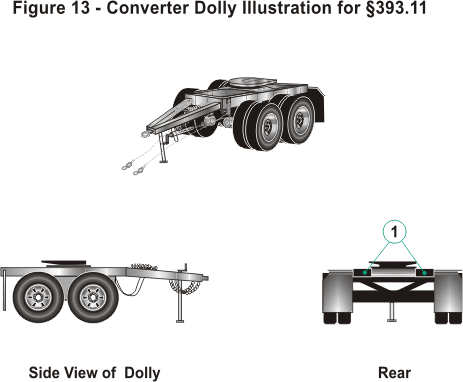
Figure 14 - Semi-Trailer Illustration for §393.11
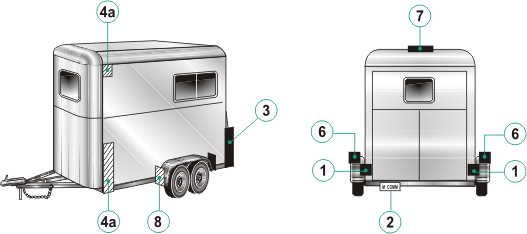
Figure 15 - Semi-Trailer Illustration for §393.11
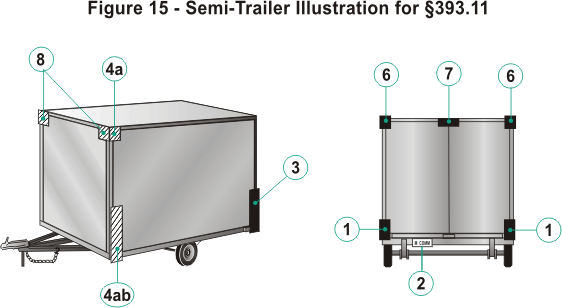
Figure 16 - Semi-Trailer Illustration for §393.11
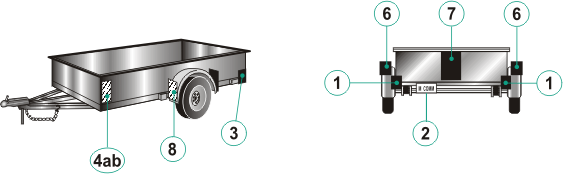
Figure 17 - Semi-Trailer Illustration for §393.11
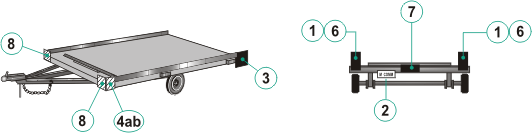
Figure 18 - Semi-Trailer Illustration for §393.11
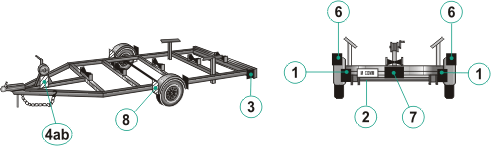
Legend for Figures 8 Through 18 — 49 CFR 393.11 Trailer Illustrations(Does not Apply to Figures 1 Through 7 for Trucks & Buses)AreaEquipment1Tail LampsStop LampsRear Turn Signal LampsRear Reflex Reflectors2License Plate Lamp(s)3Rear Side Marker LampsRear Side Reflex Reflectors4aFront Side Marker Lamps4bFront Side Reflex ReflectorsAdditional Equipment for Trailers Exceeding the Following ParametersLength 9.1 m (30 ft.) or LongerAreaEquipment5aIntermediate Side Marker Lamps5bIntermediate Side Reflex ReflectorsWidth 2.032 m (80 in.) or WiderAreaEquipment6Rear Clearance Lamps7Rear Identification Lamps8Front Clearance LampsWidth 2.032 m (80 in.) or Wider and GVWR 4,536 kg (10,000lb.) or MoreAreaDescriptionConspicuity Treatment9Rear Upper Body Marking10Bumper Bar Marking11Rear Lower Body Marking12Side Marking |
[70 FR 48027, Aug. 15, 2005, as amended at 72 FR 32014, June 11, 2007; 72 FR 33562, June 18, 2007; 78 FR 58484, Sept. 24, 2013; 81 FR 47731, July 22, 2016; 81 FR 60634, Sept. 2, 2016] §393.11 — DOT Regulatory Guidance Question 1: What is the definition of "body" with respect to trucks and trailers? Guidance: The Federal Motor Carrier Safety Regulstions (FMCSRs) do not include a definition of "body." However, a truck or trailer body generally means the structure or fixture designed to contain, or support, the material or property to be transported on the vehicle.
Question 2: May retroreflective tape be used in place of side reflex reflectors? Guidance: §393.26(b) cross references Federal Motor Vehicle Safety Standards (developed and issued by the National Highway Traffic Safety Administration) (FMVSS) 108 (49 Code of Federal Regulations (CFR) 571.108, S5.1.1.4) which allows reflective material to be used for side reflex reflectors under the conditions described below. Retro-reflective tape conforming to Federal specification L-S-300, "Sheeting and Tape, Reflective; Non-exposed Lens, Adhesive Backing," September 7, 1965, may be used in place of side reflex reflectors if this material as used on the vehicle, meets the performance standards in either Table I or Table IA of Society of Automotive Engineers J594f, Reflex Reflectors, January 1977.
Question 3: §393.11, Footnote 5, requires that each converter dolly be equipped with turn signals at the rear if the converter dolly obscures the turn signals at the rear of the towing vehicle when towed singly by another vehicle. Are turn signals required on the rear of the converter dolly when the towing of the unladen dolly prevents other motorists from seeing only a portion of the lenses of the turn signals on the towing vehicle? Guidance: Yes. Although a portion of the rear turn signal lenses on the towing vehicle may be visible to other drivers, the turn signal generally would not satisfy the visibility requirements of Federal Motor Vehicle Safety Standards (developed and issued by the National Highway Traffic Safety Administration) (FMVSS) No. 108 (49 CFR 571.108) if the converter dolly prevents other motorists from seeing the entire lens. The visibility requirements of FMVSS No. 108 help to ensure that other drivers can see the turn signal from a range of positions to the rear of the vehicle. Therefore, turn signals on the towing vehicle are considered to be obscured by the converter dolly if other motorists' view of the lens is even partially blocked.
Question 4: Does a Commercial Motor Vehicle (CMV) equipped with amber tail lamps in addition to the red tail lamps required to designate the rear of a Commercial Motor Vehicle CMV meet the lighting requirements of §393.11? Guidance: No. §393.11 requires that lighting devices on Commercial Motor Vehicle CMVs placed in operation after March 7, 1989, meet the requirements of FMVSS No. 108 in effect at the time of manufacture. The National Highway Traffic Safety Administration (NHTSA) has issued interpretations which indicate that the use of amber tail lamps impairs the effectiveness of the required lighting equipment and as such is prohibited by Federal Motor Vehicle Safety Standards (developed and issued by the National Highway Traffic Safety Administration) (FMVSS) No. 108 (S5.1.3). Since National Highway Traffic Safety Administration (NHTSA) does not allow vehicle manufacturers to install amber tail lamps, the Federal Highway Administration (FHWA) has concluded that the use of amber tail lamps on vehicles placed in operation after March 7, 1989, is prohibited by §393.11. In the case of vehicles placed in operation on or before March 7, 1989, §393.11 requires that vehicles meet either the lighting requirements of part 393 or Federal Motor Vehicle Safety Standards (developed and issued by the National Highway Traffic Safety Administration) (FMVSS) No. 108 in effect at the time of manufacture. Prior to the December 7, 1988, final rule on part 393 (53 FR 49397), amber tail lamps were prohibited by §393.25. §393.25(e)(3) (in the October 1, 1988 edition of the Code of Federal Regulations) required all rear lamps, with certain exceptions, to be red. Since tail lamps were not included in the exceptions, the use of amber tail lamps was implicitly prohibited. Therefore, a vehicle placed in operation on or before March 7, 1989, must not be equipped with amber tail lamps because the use of such lamps meets neither the lighting requirements of part 393 nor FMVSS No. 108 in effect at the time of manufacture.
|